 Marcus Rivera
Best Neck Support Pillow for Office Workers and Sleep
Neck pain is the second most common musculoskeletal complaint among office workers, trailing only lower back pain. A 2021 systematic review in BMC Musculoskeletal Disorders found that up to 67% of the general population will experience neck pain at some point, with desk workers and poor sleepers at significantly higher risk.
The good news is that the right neck support pillow, whether at your desk or in bed, can meaningfully reduce pain and prevent it from becoming chronic. This guide covers the causes of neck pain, the types of support pillows available, and how to choose the right one for both work and sleep.
Why Your Neck Hurts: The Causes
Your cervical spine supports a head that weighs approximately 4.5-5.5 kg. In a neutral position, your neck muscles handle this load efficiently. But the moment your head moves forward or tilts down, the effective load on your cervical spine increases dramatically.
A landmark 2014 study by Dr. Kenneth Hansraj in Surgical Technology International calculated that tilting your head forward by just 15 degrees increases the force on your cervical spine to approximately 12 kg. At 45 degrees, the common angle when looking down at a phone, that load reaches 22 kg. Your neck muscles were not built to sustain this kind of force for hours at a time.
Forward Head Posture
Also called "tech neck" or "scholar's neck," forward head posture is the most common cause of desk-related neck pain. For every inch your head moves forward from its neutral position over your shoulders, the load on your cervical muscles increases by roughly 4.5 kg. Most office workers with uncorrected posture carry their head 2-3 inches forward.
Poor Monitor Height
When your screen sits too low, you tilt your head downward for hours. When it is too high, you extend your neck backward, compressing the posterior cervical structures. Both create sustained muscular tension that leads to pain, headaches, and stiffness.
Sleep Position
Your neck spends 6-8 hours in whatever position your pillow dictates. A pillow that is too high pushes your neck into lateral flexion (side sleepers) or forward flexion (back sleepers). Too flat, and your neck drops, straining the opposite structures. Poor sleep posture compounds daytime neck stress, creating a cycle where you never fully recover.
Neck Pain from Office Work
Office-related neck pain follows a predictable pattern. It typically begins as mild stiffness in the late afternoon and progresses over weeks or months to persistent discomfort that may include headaches, shoulder tension, and reduced range of motion.

The mechanics are straightforward. Your upper trapezius and levator scapulae muscles, which run from your shoulder blades to the base of your skull, remain in a contracted state when your head is positioned forward of your shoulders. After hours of sustained contraction, these muscles develop trigger points, localized areas of tightness that refer pain to the neck, head, and shoulders.
Text neck adds another layer. Looking down at a phone or tablet during breaks does not relieve the cervical strain from desk work. It increases it. The average office worker now spends time looking at screens in both directions, forward at a monitor and downward at a phone, leaving very little time for the cervical muscles to rest in a neutral position.
Types of Neck Support Pillows
Neck support pillows fall into four main categories, each designed for specific use cases.
Cervical Contour Pillows
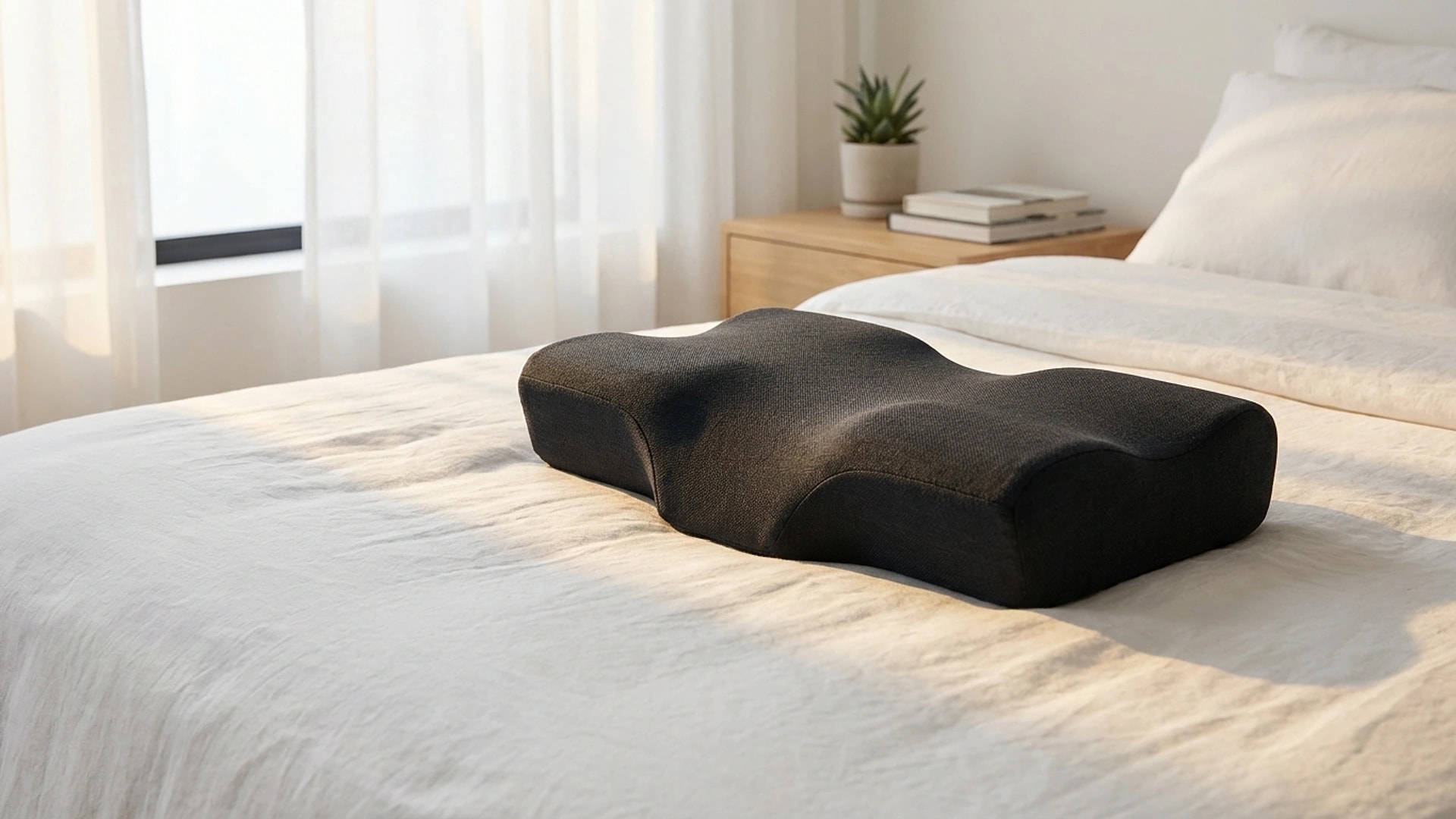
These pillows have a wave-shaped profile with a raised front and rear edge and a lower center area that cradles the head. They are designed primarily for sleeping and maintain the natural C-curve of the cervical spine in both back-sleeping and side-sleeping positions. The contour depth should match the distance between your neck and the sleeping surface.
Cervical Roll Pillows
A cylindrical bolster that fits in the curve of your neck. Rolls can be used in a chair for desk work, behind the neck while sleeping, or during travel. They are simple and effective but provide support in only one dimension. The ERGOLA Neck Support Pillow uses a contoured design that supports the cervical curve from multiple angles.
Travel Neck Pillows
U-shaped pillows designed for use in planes, cars, and trains. They prevent your head from dropping to the side when you doze off in a seated position. They are not ideal for daily office use but serve a purpose for workers who travel frequently.
Adjustable Neck Pillows
These allow you to add or remove fill material (usually shredded foam or buckwheat hulls) to customize the height and firmness. They offer the most personalization and are a good option if you have tried standard pillows that are consistently too thick or too thin.
What to Look for When Buying
The wrong neck pillow can make your pain worse. Here is what matters:
- Material: Memory foam contours to your neck shape and maintains support throughout the night. Latex offers similar support with more resilience (bounces back faster). Fiber fill is softer but provides less consistent support.
- Contour height: This is the most critical measurement. For back sleepers, the contour should be 8-10 cm high. Side sleepers need 10-14 cm to fill the gap between the shoulder and the head. Combo sleepers should look for pillows with different heights on each side.
- Height adjustability: Removable inserts or adjustable fill allow you to fine-tune the height. This is valuable because even a 1 cm difference can affect comfort and spinal alignment.
- Cover material: Breathable, removable, and machine-washable covers extend the pillow's life and hygiene. Bamboo-derived fabrics and Tencel offer good temperature regulation.
Using a Neck Pillow at Your Desk
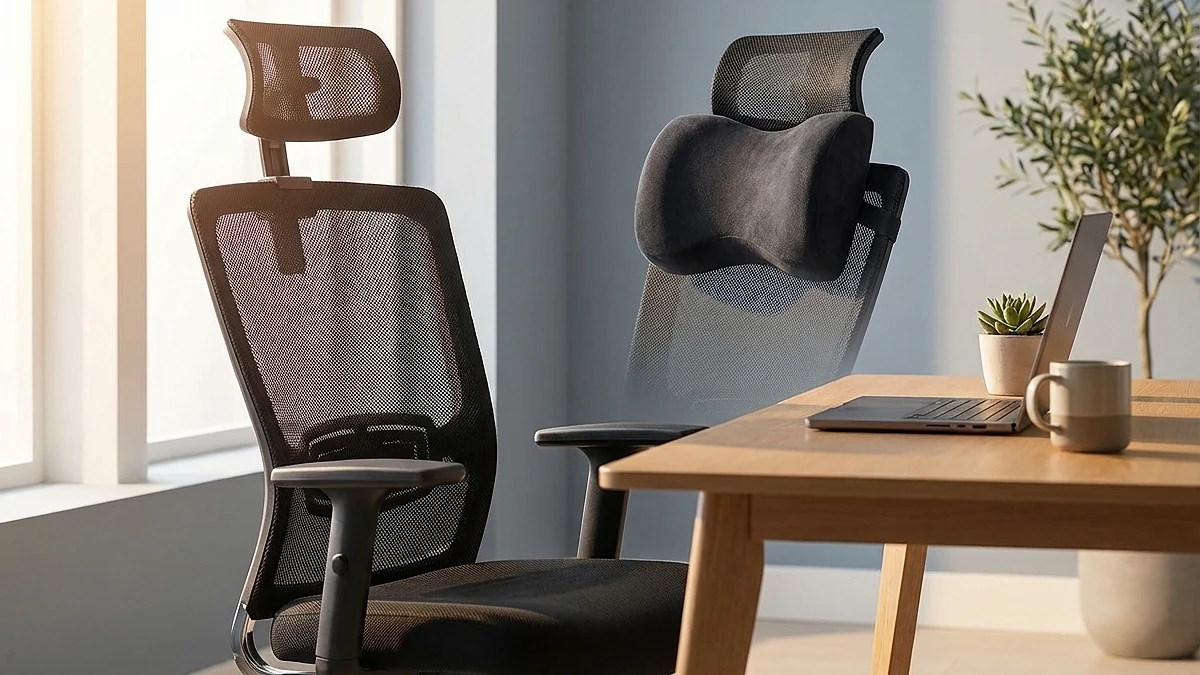
Most people associate neck pillows with sleep, but they can be equally valuable during work hours. Attaching a cervical support to your office chair's headrest area provides passive support that prevents your head from drifting forward during focused work.
How to Position a Neck Pillow on Your Chair
The pillow should sit at the base of your skull, supporting the natural curve of your cervical spine. It should not push your head forward. If your chair has a headrest, place the pillow between the headrest and your neck. If it does not, some neck pillows come with straps that attach to the chair back.
The key is that the pillow supports your neck, not your head. Your head should rest naturally balanced on top of your spine, with the pillow preventing the cervical curve from flattening. If you feel the pillow pushing your chin toward your chest, it is too thick or positioned too high.
Combining With Lumbar Support
Neck position does not exist in isolation. When your lower back collapses due to poor lumbar support, your upper back rounds forward, which pushes your head forward, which strains your neck. A lumbar support pillow at your lower back can reduce neck strain by maintaining the spinal alignment chain from pelvis to head. For more on this, see our evidence-based lumbar support pillow guide.
Neck Pillows for Sleep
Sleep is when your cervical spine has the longest uninterrupted period to either recover or sustain further damage. The right pillow alignment during sleep can undo much of the tension accumulated during the workday.

Back Sleepers
Back sleepers need a pillow that supports the cervical curve without pushing the head forward. A contour pillow with a lower center and raised neck edge is ideal. The head should rest in a neutral position where your ears align with your shoulders, not tilted forward or backward.
Side Sleepers
Side sleepers require a thicker pillow to fill the space between the shoulder and the head. The pillow should keep the cervical spine in a straight horizontal line. If the pillow is too thin, your head drops toward the mattress, compressing the nerves on the lower side. Too thick, and your neck bends upward, straining the muscles on the upper side.
Combo Sleepers
If you shift between positions, look for a pillow with different heights on each side, lower for back sleeping, higher for side sleeping, or an adjustable pillow that accommodates both positions without waking you up to rearrange.
The Adjustment Period
A new cervical pillow may feel unusual for the first 3-7 nights, especially if you have been sleeping on the wrong pillow for years. Your muscles need time to adapt to a new position. If discomfort has not improved after 10-14 days, the pillow height or firmness is likely not right for you.
Common Mistakes
Avoiding these common errors ensures your neck pillow actually helps rather than creating new problems:
- Too thick: The most common mistake. A pillow that is too high forces your neck into flexion (back sleepers) or lateral flexion (side sleepers), straining the muscles it should be relaxing.
- Wrong position on the chair: Placing the pillow behind your mid-back or upper back instead of directly at the cervical curve. Support needs to be at neck level.
- Using a desk pillow during active typing: Neck pillows are for resting postures, not for leaning against while reaching forward to type. When actively working, your posture should be self-supporting with the pillow as passive backup.
- Ignoring the rest of the chain: A neck pillow cannot compensate for a monitor that is 30 cm too low or a chair that provides no back support. Address the full ergonomic setup.
- Never replacing it: Memory foam pillows lose their support over time. If your cervical pillow is more than 2-3 years old and no longer springs back to shape, it needs to be replaced.
The Bottom Line
Neck pain from office work and poor sleep is addressable with the right support. A cervical neck pillow, used correctly at your desk and in bed, maintains the natural curve of your cervical spine and prevents the muscular strain that leads to chronic pain.
Start with your sleep pillow, since that is where your neck spends the most uninterrupted time. Choose a contour that matches your sleep position and give it two weeks to adjust. Then add cervical support to your chair and ensure your overall workstation ergonomics are not undermining the benefit. The combination of proper daytime and nighttime neck support can break the cycle of tension that keeps so many office workers in pain.